What we studied in Phase 1

This first phase of study looked at the market opportunities of commercial passenger and cargo service at Bremerton National Airport (PWT).


To perform this analysis, our consultant team looked into:

  • Regional and industry air service and travel trends
  • The potential regional area of passenger demand
  • Cargo export and imports by state, country, and commodity
  • Benchmarking against peer states and airports


On Feb. 25, 2025 the consultant team presented our Commissioners with an update on the results of this analysis. Keep reading below for a summary of the findings.

Market feasibility results

Cargo service recommendation:

Not recommended for additional study


Rationale:

  • PWT’s relative distance to I-5 and major population centers make it unattractive to potential air cargo partners. 
  • Only 0.1% of 2023 WA exports originated in the Bremerton-Silverdale-Port Orchard area – not enough to sustain scheduled or charter air cargo service.
  • Cargo service at PWT would not achieve local or state economic planning objectives.
  • SEA still has capacity to increase cargo volumes so competition from SEA would remain challenging.

Commercial passenger service recommendation: 

There is sufficient potential demand to warrant further exploration.


Rationale:

  • Data analysis points at demand from PWT’s catchment area being ~2.6% of SEA air travel.
  • Select markets are large enough for service consideration.
  • Some comparable airports have succeeded in starting commercial service but it is a multi-year effort.
  • Hurdles to new service will include industry trends currently suppressing growth and demonstrating the viability of travelers using PWT over SEA.


  • Additional detail from Phase 1 commercial passenger assessment:
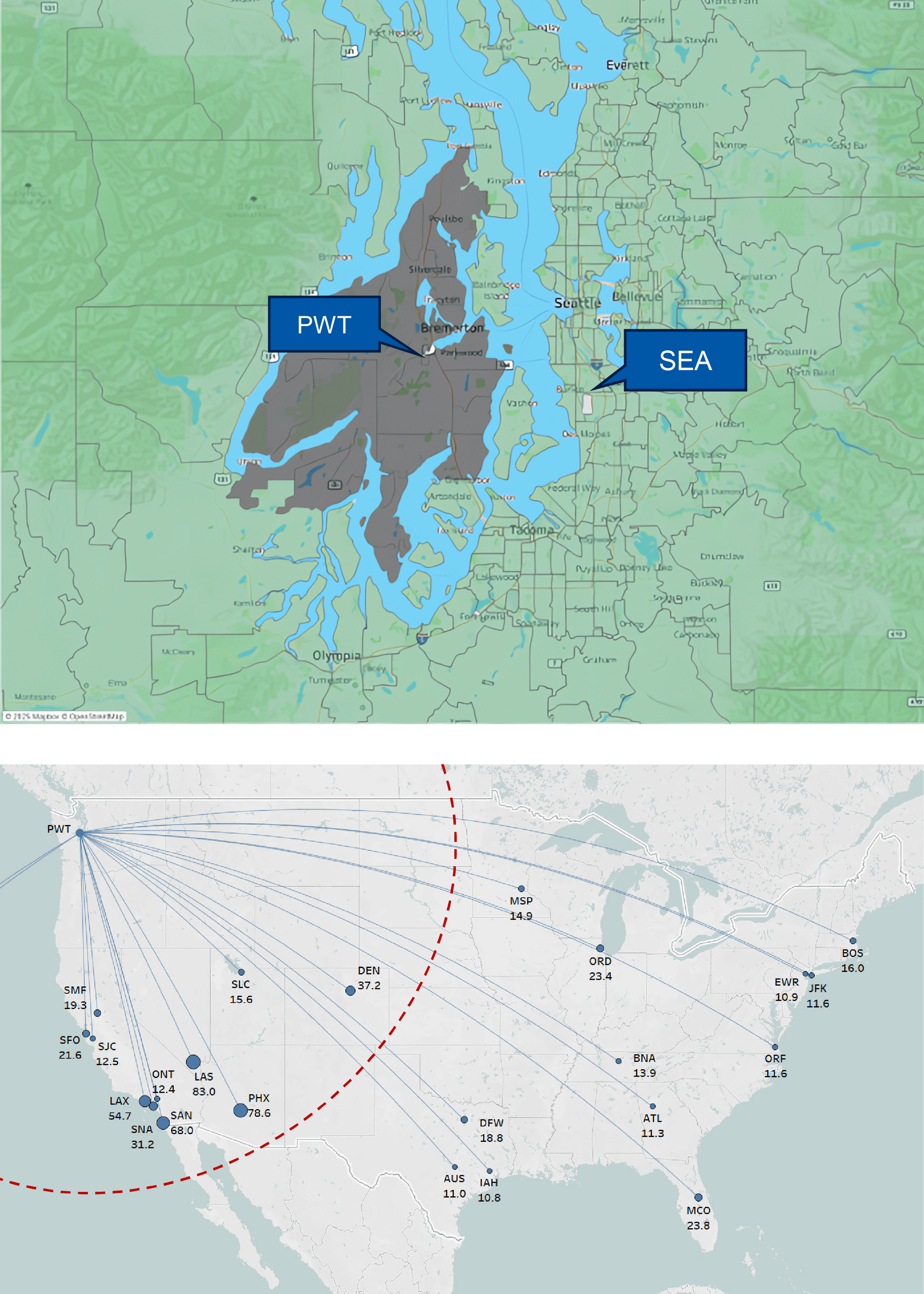
    In Phase 1 we studied PWT’s potential demand region (the catchment area):


    • Catchment areas are typically 90-120 minutes by car from the airport.

    • In multi-airport catchments, studies have shown airports similar to PWT have compacted catchments due to nonstop flight offerings at the other, larger airport (SEA).

    • While areas west of PWT are closer to PWT than SEA, studies have shown passengers will drive to the larger airport when drive time differences become marginal.


    Top potential markets from PWT:

    • Highest-demand markets are leisure and sun destinations (Las Vegas, Los Angeles, San Diego, Phoenix).
    • Destinations with Naval bases (San Diego, Norfolk, Honolulu) generate a larger share of SEA demand from the PWT catchment area than other domestic markets.
    • Market demand significantly decreases for destinations east of Denver.


What we heard from our community in Phase 1

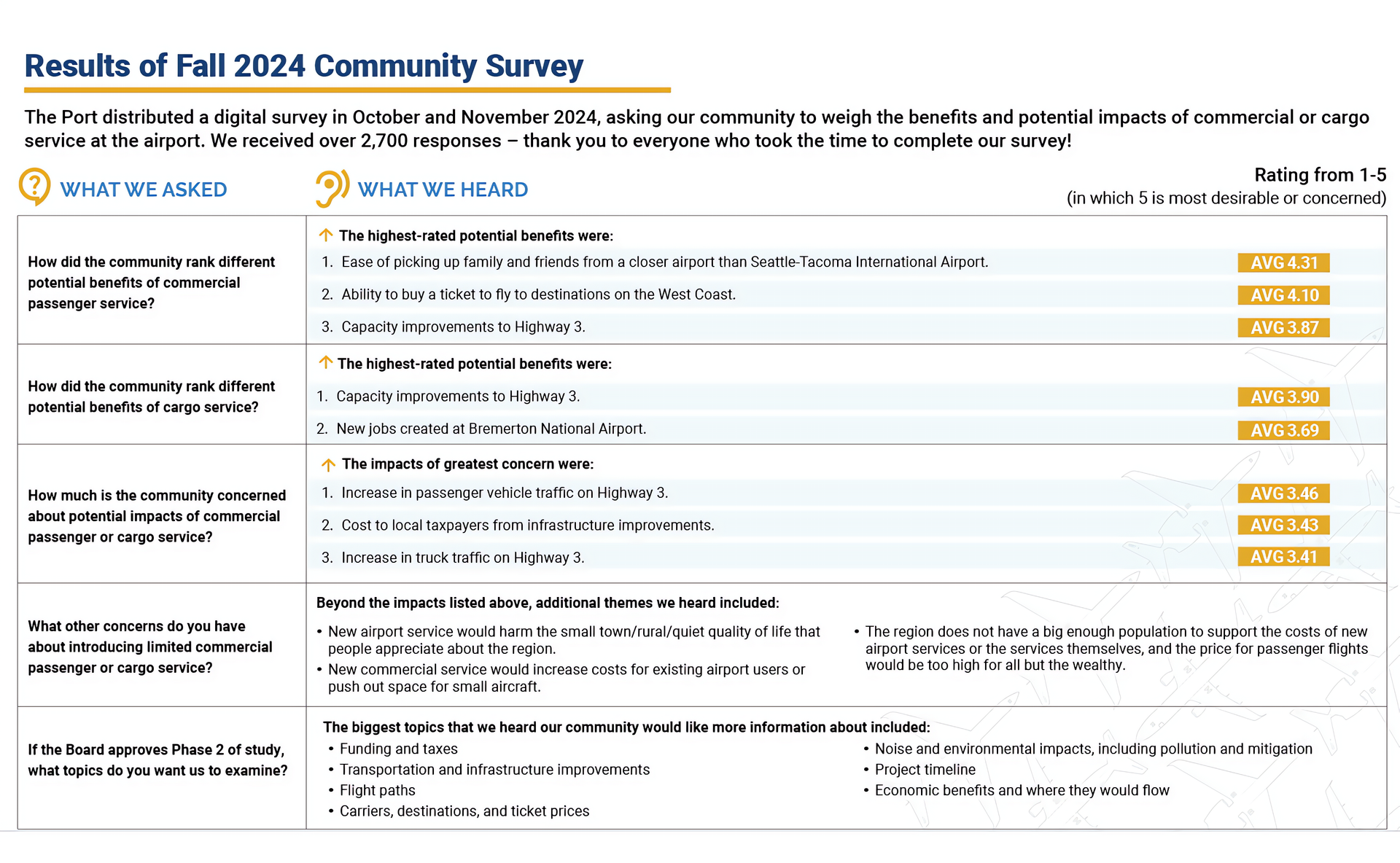
Our community’s interests and priorities for Bremerton National Airport are a crucial part of this study. In fall 2024 we distributed a digital survey asking our community to weigh the potential benefits and impacts of commercial passenger or cargo service at PWT.


These results were shared with the Board of Commissioners in December 2024 to consider alongside the results of the market feasibility study.
2025 Comment Period

In February 2025 the Port shared the findings of the market feasibility study with the public. Community members were invited to attend the Feb. 25 Board of Commissioners meeting to hear a presentation on the study, offer verbal or written comment, and chat with Port and consultant staff in an information session afterward.


We updated this website with the Phase 1 findings and opened a digital survey to collect additional community input on whether the Phase 1 findings changed our community’s priorities or concerns regarding the airport.


We closed the public comment period on March 6 and shared all input with the Board for consideration.


Results of the Spring 2025 Public Information Session and Comment Period

Approximately 20 people attended the meeting on Feb. 25 in person, along with a few virtual participants. Ten people spoke during the public comment portion of the Commission meeting and four submitted written comments via the comment box. Following the meeting, 12 additional comments were shared via the online open house, along with one email and a handful of comments on social media related to the study.

Comments were grouped into the following themes:


Potential Benefits 

  • Easier travel options
  • Closer airport pick-ups and drop-offs for visiting family and friends
  • Increased economic investment in the area
  • Opportunity to improve traffic conditions
  • Local job opportunities


Concerns

  • Worsening traffic on Highway 3
  • Increased noise and pollution from larger planes
  • Cost of new infrastructure to taxpayers
  • Flights out of PWT being too expensive to choose over flights out of SEA
  • Potential for displacing existing airport tenants, including military and civil air patrol pilot training programs
  • Limited representation for people living in Belfair (outside the Port’s district) 


Frequently Asked Questions

  • Does the Port have a preferred outcome?

    No. The Port is conducting its due diligence to see whether adding commercial passenger services would bring jobs and economic opportunities to our community, as well as exploring its effect on the local quality of life. Once the Port has a clearer picture of community priorities, available economic opportunities, and the likely associated costs and impacts, the Board of Commissioners will determine whether to take any next steps.

  • If the Port decides to pursue commercial service, who will pay for the needed expansion?

    It is too early to say. Federal or state funding may be available, depending on the type of improvements involved in expanding airport service. Many times, private-sector companies have an interest in this type of investment as well. 

  • How is this study related to the Washington State Commercial Aviation Work Group?

    This study is not connected to the work being performed by the Commercial Aviation Work Group.  It is independent and intended to assess the market feasibility specific to the Bremerton National Airport while considering the feedback the Port receives from the communities it serves.    


    Click here for more information about the Commercial Aviation Work Group.

  • If this process takes years, will the market analysis remain accurate by the time construction begins?

    If the Port decides to move forward with infrastructure improvements that would support the introduction of air service, continuous effort would be needed throughout design and construction to market to specific airlines. This would include refreshing market data, monitoring industry changes and market conditions, and meeting with airlines to present our business case and explore interest.

  • Would starting commercial passenger service require Highway 3 to be expanded?

    The traffic study we conducted in 2026 found that traffic conditions on SR 3 will be challenging with or without the introduction of commercial passenger service. Any changes to Highway 3 or other nearby roads must be planned and coordinated with local jurisdictions and the Washington State Department of Transportation.

  • Would new airport service require building a new, or longer, runway?

    The current analysis finds that Bremerton National Airport would not need a longer or a second runway to attract and operate commercial passenger service. Infrastructure changes to the taxiway would be required but all improvements would occur on the airport’s existing footprint.

  • What would be the environmental impacts of new airport service?

    We studied noise and traffic impacts from commercial passenger service, and those findings are available on this website. Should the Port choose to continue exploring service and obtain funding to make infrastructure improvements, the permitting process would involve a more detailed environmental review.